
TUAMOTUS TIGER SHARK STUDY
BACKGROUND
In November 2018 we traveled to the remote Tuamotus in search of tiger shark population hotspots. It is believed that the large female tiger sharks migrate between the main island of Tahiti and the islands of the Tuamotus as a part of reproductive pattern. We connected with local fishermen, who are often the most educated on shark movement patterns and habitat spatial array, in order to locate a hotspot where tiger sharks may congregate outside of the infamous La Vallee Blanche of Papeete.
“Tiger lagoon”
During our search we were led by fishermen to a protected lagoon in which tiger sharks were congregating naturally in a larger than average number socially as well as exhibiting a longer than average residency within the area. The tiger sharks observed primarily range between juvenile to adult. This is our primary site we are conducting surveys on, however we are in search of similar sites throughout the area of French Polynesia.

OBJECTIVES:
Photo identification
Using imagery to document individual tiger sharks using the facial countershade line, dorsal ridge and pattern, along with any distinct features can help us better understand a population baseline for this region (how many individuals use the area). Photo identification programs also allow us to observe growth rates, pregnancies, wound healing timelines, behavioral change, and more by observing the same individual multiple times over a length of time. Currently we have 40+ unique individuals documented at this site ranging from sub-juveniles at less than 1.5 meters in length to our largest, fully mature female nearing 5 meters.
behavioral studies
Understanding shark behavior—and how it shifts with individual traits like size or sex, or environmental forces such as currents, tides, visibility, or lunar cycles—reveals far more than movement patterns. Paired with cutting-edge biologging tools like fin-mounted video cameras, these data allow us to witness the shark’s world from its own perspective, uncovering the precise conditions that foster safe, positive human–shark interactions and identifying moments when avoidance is crucial. Behavioral research also opens a window into the cognitive abilities of these apex predators: how they learn, adapt to new patterns, respond to provisioning cues, and weigh risk versus reward. Every shark provides a distinct behavioral profile—no two individuals, even within the same species, express their ecology in exactly the same way. Social network analyses further illuminate how these sharks interact in shared spaces, revealing hidden associations, hierarchies, and the social fabric of their complex oceanic communities.
genetic kinship
Understanding the relationship between the individual sharks at this site assists us in better understanding the relationship between these tigers and the importance of protecting juvenile residency areas such as Tiger Lagoon. We have collected genetic samples from 20 individuals at this site. Samples are currently being analyzed for kinship.
acoustic tagging
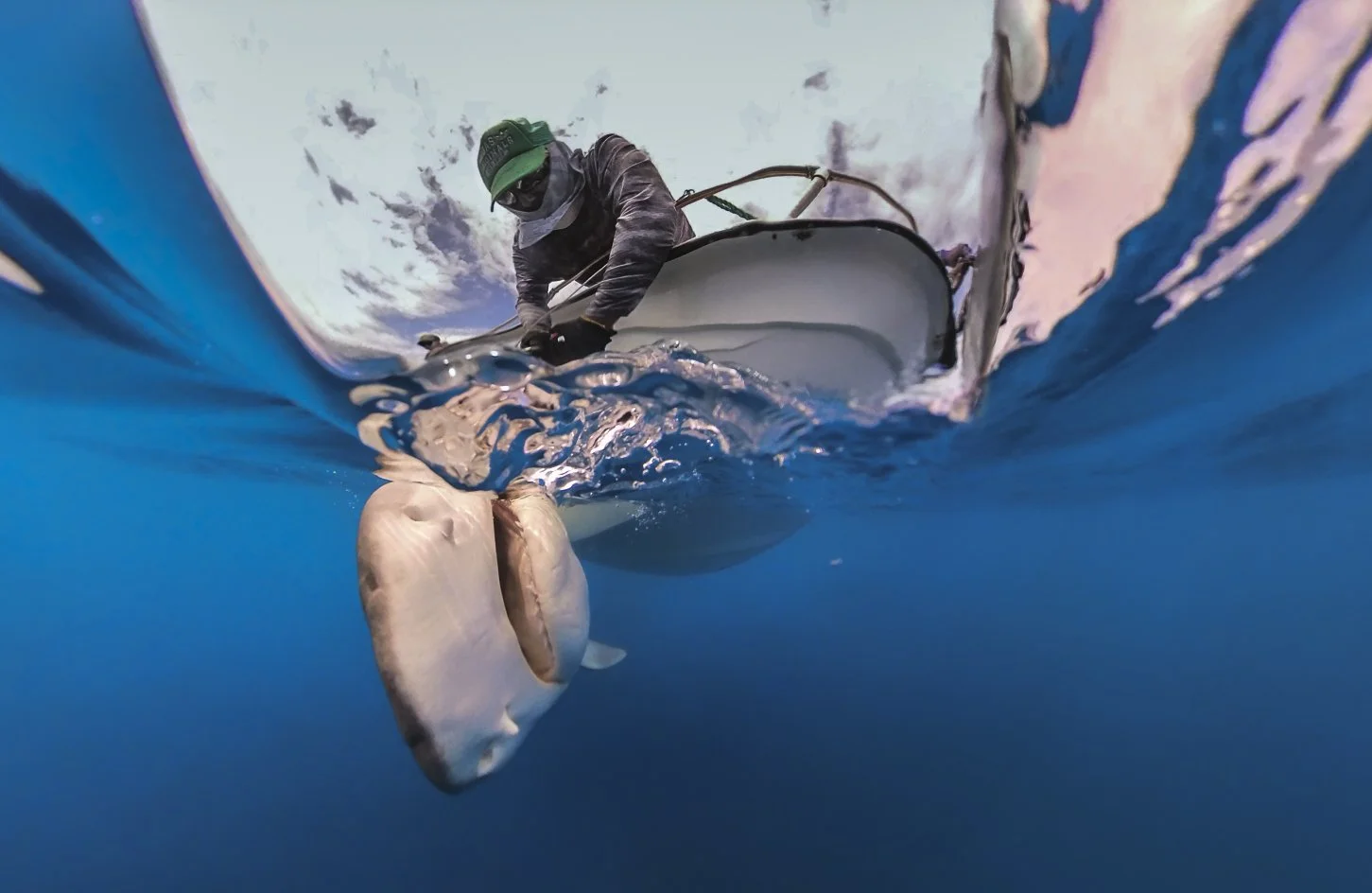
We surgically implanted acoustic transmitters into 20 tiger sharks using a quick, minimally invasive procedure performed alongside the boat, allowing for secure long-term tracking with minimal stress to the animals. These tags enable researchers to monitor fine-scale movement patterns, habitat residency, and site fidelity within the lagoon and surrounding reef systems. By analyzing these long-term detection records, we can better understand how tiger sharks use space, how they interact with environmental features, and how their presence overlaps with human activities—critical information for both conservation and safety management.
conservation
Our top priority in these studies in these remote locations is to promote a positive message about the tiger sharks and to work in alliance with local fishermen to help them better coexist alongside a highly misunderstood and feared species. The implementation and inclusion of fishermen in this project for citizen science initiatives allows population monitoring by those who are most immersed with the tiger sharks of the lagoon.
Example fin-cam footage of a tiger shark patrolling the lagoon and ending up being caught by a local fisherman. The non-invasive fin cam was shaken off the shark during its fight against the fisherman, for which the shark broke the line and swam away freely.